
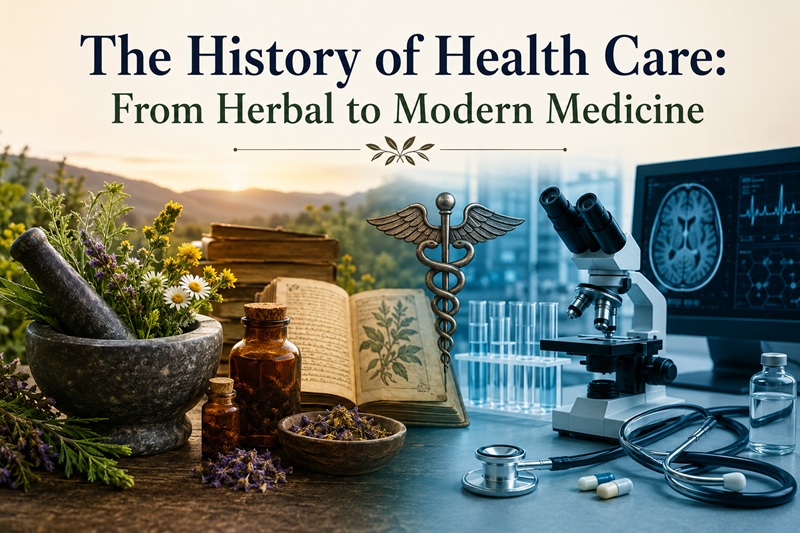
For most of human history, health care looked very different from what we know today.
There were no modern hospitals, antibiotics, X-rays, blood tests, or pharmacies filled with standardized medications. People relied heavily on plants, foods, traditional remedies, practical experience, and the knowledge passed from one generation of healers to another.
Key Takeaway: Health care didn’t change from herbal remedies to modern medicine overnight. Scientific discoveries, better medical training, the Flexner Report, and major funding from organizations backed by Carnegie and Rockefeller all helped reshape medicine. The result brought enormous advances in diagnosis and treatment. However, many traditional and herbal approaches moved outside mainstream medical education.
This isn’t a story about choosing between herbal medicine and modern medicine. Both are part of the history of health care. I wanted to understand how we moved from one system to another, what drove that change, what modern medicine gave us, and what may have been pushed aside along the way.
Scientific discoveries transformed our understanding of the human body and disease. Chemistry allowed active compounds to be isolated from medicinal plants. Germ theory changed the way doctors understood infection. Surgery became safer. Medical schools became more standardized.
Then, during the late 1800s and early 1900s, another major transformation occurred in the United States. Medical education moved toward a university-based, laboratory-centered model. The Carnegie Foundation, Abraham Flexner, John D. Rockefeller, and Rockefeller-funded organizations all played important roles in that change.
The result helped create the medical system we recognize today.
But the transition also pushed many older approaches—including botanical, homeopathic, eclectic, and other forms of medicine—outside mainstream medical education.
Understanding how that happened helps explain both the strengths of modern medicine and why there is renewed interest today in nutrition, lifestyle, herbs, and more integrative approaches to health.
How Did People Treat Illness Before Modern Medicine?
Humans were treating injuries and illness thousands of years before modern medicine existed.
Early healers learned largely through observation and experience. They discovered that certain plants affected pain, digestion, wounds, fever, sleep, and other conditions.
Knowledge was passed down through families and communities.
Different cultures developed their own systems of medicine. Egyptian medical writings described remedies and surgical procedures. Traditional Chinese medicine developed over thousands of years. Ayurveda developed in India. Greek physicians developed theories about health and disease that later influenced European medicine.
Not all early treatments worked. Some were ineffective, and others were dangerous.
But traditional medicine also accumulated genuine knowledge.
Plants in particular became an important starting point for what eventually developed into modern pharmacology. Researchers continue to use natural compounds as sources and models for medicines today.
Herbal Medicine Came Before the Modern Pharmacy
Medicinal plants weren’t simply an alternative to early medicine. For much of history, plants were medicine.
A few familiar examples show the connection.
Willow Bark and Aspirin
Willow had been used medicinally for centuries. It contains compounds related to salicin.
Modern chemistry eventually led from the study of willow-derived salicylates to acetylsalicylic acid, better known as aspirin.
Foxglove and Digitalis
Foxglove was used as an herbal remedy before its effects were systematically studied.
In the 18th century, English physician William Withering documented the use of foxglove for dropsy, a condition involving fluid accumulation that was often associated with heart disease.
Digitalis compounds derived from foxglove subsequently became important heart medicines.
Opium Poppy and Morphine
Opium poppies had been used medicinally since ancient times.
In the early 1800s, morphine was isolated from opium. This was an important step because scientists could now isolate a specific active chemical rather than rely on a preparation containing an unpredictable mixture of compounds.
That made more precise dosing possible.
Cinchona Bark and Quinine
Cinchona bark became an important treatment for malaria.
Quinine was eventually isolated from the bark and became an important antimalarial drug.
These examples show that herbal medicine and pharmaceutical medicine aren’t completely separate worlds. Part of modern pharmacology grew directly from studying substances found in nature.
Medicine Begins to Become a Science
For centuries, physicians had relatively limited ability to determine what was happening inside a sick person.
That began changing rapidly during the 18th and especially the 19th centuries.
Anatomy became better understood. Chemistry advanced. Microscopes improved. Physicians became better able to connect symptoms with changes occurring inside organs and tissues.
Then several discoveries dramatically accelerated the transformation.
Vaccination
In 1796, Edward Jenner demonstrated vaccination against smallpox using material related to cowpox.
Vaccination would eventually become one of the most important tools for preventing infectious disease.
Anesthesia
Surgery before reliable anesthesia is difficult for us to imagine today.
During the first half of the 19th century, physicians and dentists experimented with substances including nitrous oxide and ether. By the 1840s, anesthesia was beginning to make longer and more complicated surgery possible.
Germ Theory
One of the biggest changes came from understanding microorganisms.
Work by scientists including Louis Pasteur and Robert Koch helped establish that microorganisms could cause disease.
This overturned older ideas about the causes of many illnesses and gave medicine a scientific explanation for infection.
Antiseptic Surgery
Joseph Lister applied ideas about microorganisms to surgery during the 1860s.
Antiseptic techniques dramatically changed what surgeons could safely attempt because infection had previously been one of surgery’s greatest dangers.
X-Rays
Wilhelm Röntgen’s discovery of X-rays in 1895 gave physicians something they had never had before: the ability to look inside a living body without cutting it open.
Medicine was becoming increasingly based on measurable biological processes rather than primarily on tradition and observation.
Health Care in America During the 1800s
There wasn’t one unified system of medicine in 19th-century America.
Different medical philosophies competed with one another.
There were conventional physicians, homeopaths, eclectic physicians, botanical practitioners, midwives, osteopathic physicians, and numerous other healers.
Medical education was equally inconsistent.
Some medical schools provided serious education. Others operated more like businesses selling medical training.
Admission standards varied enormously.
A student didn’t necessarily need the type of college education required to enter medical school today. Laboratories could be poor or nonexistent. Clinical training varied greatly from one school to another.
By the end of the 19th century, physicians and educators were increasingly calling for reform.
Medical Education Was Already Changing
This part of the story is important because it corrects a common misconception.
John D. Rockefeller did not simply create modern medicine or modern medical education.
The move toward scientific medical education had already begun.
Universities were strengthening medical training during the late 19th century. Johns Hopkins University became particularly influential when its medical school opened in 1893.
The emerging model combined:
- Basic sciences
- Laboratory work
- Clinical experience
- Hospital training
- Higher admission standards
Medical education was gradually becoming something that belonged inside research universities rather than small proprietary schools.
But the transition was about to accelerate dramatically.
Who Was Abraham Flexner?
Abraham Flexner is one of the most important—and sometimes misunderstood—figures in American medical history.
Interestingly, Flexner wasn’t a physician.
He was an educator.
Henry Pritchett, president of the Carnegie Foundation for the Advancement of Teaching, commissioned Flexner to investigate medical education in the United States and Canada.
Flexner visited and evaluated 155 medical schools.
The result was published in 1910 as Medical Education in the United States and Canada.
Today it is usually called the Flexner Report.
What Did the Flexner Report Find?
Flexner found enormous differences between medical schools.
Some had strong laboratories, qualified professors, hospitals, and serious academic programs.
Others did not.
The report criticized inadequate admission requirements, poor laboratory facilities, weak clinical training, and schools that Flexner believed were operating primarily for profit.
Flexner argued that medical education should be standardized around science.
Students should first study subjects such as:
- Anatomy
- Physiology
- Chemistry
- Pathology
- Pharmacology
They should then receive clinical training in hospitals under experienced physicians.
This basic idea—scientific education followed by supervised clinical education—became the foundation of modern American medical training.
The Carnegie Foundation itself describes the Flexner Report as helping transform medical education into the general structure that remains recognizable today.
What Happened to the Other Medical Schools?
This is where the history becomes more complicated.
Schools unable to meet the new academic, laboratory, and financial requirements increasingly closed or merged.
That included poorly equipped conventional medical schools.
But it also affected schools teaching medical systems that didn’t fit well within the emerging biomedical model.
Homeopathic and eclectic medical schools were among them.
Eclectic physicians are particularly interesting in the history of herbal medicine because they often emphasized botanical remedies while also drawing from other medical approaches.
As scientific medicine became dominant and educational requirements became more expensive, many of these competing medical traditions lost their place within mainstream medical education.
This didn’t mean medicinal plants disappeared.
Instead, medicine increasingly focused on identifying, isolating, standardizing, and testing active compounds.
The plant might eventually disappear from the doctor’s office while a purified or modified compound derived from it remained in the pharmacy.
What Role Did the Carnegie Foundation Play?
Andrew Carnegie’s Carnegie Foundation for the Advancement of Teaching commissioned and published Flexner’s report.
That’s an important distinction because the Flexner Report is sometimes incorrectly described as a Rockefeller report.
It wasn’t.
It was a Carnegie Foundation report.
The Carnegie Foundation wanted to improve professional education, and medicine was one of the professions it investigated.
The report provided a blueprint.
But implementing that blueprint required something else:
money.
Scientific medical education was expensive.
Medical schools needed laboratories, equipment, hospitals, full-time faculty, and research facilities.
That’s where Rockefeller philanthropy became especially important.
Some people claim that, because of money, modern medicine “forced” old medicine out of there by using questionable methods.
What Role Did Rockefeller Play in Modern Medicine?
John D. Rockefeller was one of the wealthiest men in American history.
He and the organizations funded with his fortune became major supporters of scientific medicine, medical research, public health, and medical education.
But Rockefeller’s involvement actually began before the Flexner Report.
The Rockefeller Institute for Medical Research
The Rockefeller Institute for Medical Research was founded in 1901.
Its purpose was to advance biomedical research.
It later became Rockefeller University and produced major scientific discoveries.
Frederick T. Gates
Another important person in this story was Frederick T. Gates.
Gates had been a Baptist minister before becoming one of Rockefeller’s most influential philanthropic advisers.
He strongly supported scientific medicine and helped direct Rockefeller philanthropy toward medical research and education.
The General Education Board
Rockefeller established the General Education Board in 1902.
After Flexner’s report, the General Education Board and later the Rockefeller Foundation provided substantial funding to medical schools willing and able to develop the scientific model of education Flexner advocated.
Rockefeller money didn’t invent that model.
But it provided enormous financial power to help build it.
The Rockefeller Archive Center describes Flexner’s report as profoundly influencing Rockefeller and notes that the General Education Board and Rockefeller Foundation subsequently pushed for investment and transformation in medical education.
Did Rockefeller Create Modern Medical Education?
No—not by himself.
That’s too simple.
A more accurate description is:
Scientific discoveries created the foundation. Universities began reforming medical education. The Carnegie Foundation commissioned Flexner to evaluate the system. Flexner’s 1910 report provided an influential blueprint for reform. Rockefeller-funded organizations then supplied substantial financial resources that helped institutions implement and expand that model.
Together, these forces changed medicine.
And they changed it dramatically.
The Rise of the Biomedical Model
The new system put biological science at the center of medicine.
Doctors increasingly learned to think in terms of:
symptoms → diagnosis → biological cause → treatment
Laboratory testing became increasingly important.
Pathology became more sophisticated.
Pharmacology became a scientific discipline.
Hospitals became centers of medical treatment, education, and research.
The ability to isolate specific chemical compounds also changed medicines themselves.
Instead of prescribing willow bark, medicine could eventually use standardized salicylate-derived drugs.
Instead of relying on varying foxglove preparations, physicians could use standardized digitalis compounds.
Instead of raw opium, specific opioid compounds could be measured and prescribed.
Standardization had a major advantage: doctors could know much more precisely what substance was being given and how much.
The Pharmaceutical Era
The pharmaceutical industry developed alongside advances in chemistry, biology, manufacturing, and medical research.
This wasn’t simply a replacement of natural substances with artificial ones.
Many important pharmaceuticals originated directly or indirectly from natural sources.
Examples include:
Morphine — opium poppy
Digoxin — foxglove
Quinine — cinchona
Aspirin — developed through chemistry connected to salicylates found in willow
And natural products continue to contribute to drug discovery today.
But pharmaceutical medicine offered something traditional herbal preparations often couldn’t provide:
standardization.
A tablet could contain a measured amount of a known compound.
That was an enormous step forward in controlling dosage and studying both effectiveness and side effects.
What Modern Medicine Gave Us
It would be difficult to overstate the accomplishments of modern medicine.
The transition to science-based medicine eventually contributed to advances that earlier generations could hardly have imagined.
Antibiotics
Alexander Fleming discovered penicillin’s antibacterial properties in 1928, although widespread clinical use came later.
Antibiotics transformed the treatment of bacterial infections that previously could easily become fatal.
Insulin
Insulin was first successfully used to treat diabetes in the early 1920s.
Before insulin therapy, type 1 diabetes was generally fatal.
Blood Transfusions
Understanding blood types and improvements in blood storage eventually made transfusions far safer and more useful.
Modern Surgery
Anesthesia, antisepsis, antibiotics, imaging, blood transfusion, and improved surgical techniques made operations possible that would have been unimaginable a century earlier.
Medical Imaging
X-rays were followed eventually by ultrasound, CT scans, MRI, and other technologies that allow physicians to see inside the body.
Emergency Medicine
Someone suffering a serious accident, heart attack, stroke, severe infection, or traumatic injury today has treatment options that simply didn’t exist for most of human history.
These are genuine achievements of modern medicine.
What May Have Been Pushed Aside?
The transformation also raises another question.
As medicine became increasingly specialized and focused on identifying and treating specific diseases, what happened to older ideas about food, lifestyle, plants, prevention, and treating the person as a whole?
Some traditional practices disappeared because they didn’t work.
That’s important to acknowledge.
Old doesn’t automatically mean effective.
Natural doesn’t automatically mean safe.
But other traditional knowledge didn’t simply vanish.
Some medicinal plants became starting points for pharmaceuticals. Others continued to be used outside mainstream medicine. Nutrition, exercise, sleep, stress, and other lifestyle factors eventually became major areas of scientific research themselves.
And many people continued using traditional remedies even when their doctors didn’t.
Herbal Medicine Never Really Disappeared
Despite the rise of pharmaceuticals, medicinal plants continued to be used throughout the world.
And scientists never stopped studying nature for useful compounds.
Plants, fungi, microorganisms, and other natural sources have contributed to numerous modern drugs.
What changed was largely how mainstream medicine evaluated and used them.
Traditional use might begin with:
This plant has helped people with this problem for generations.
Modern pharmacology asks additional questions:
What chemicals are in it?
Which compound produces the effect?
What dose works?
What are the side effects?
How does it interact with other medications?
Can we reproduce the same result consistently?
Those questions have made medicine safer in many ways.
They also illustrate why traditional knowledge and modern science don’t necessarily have to be enemies.
The Return of Interest in Natural and Integrative Health
During the late 20th century and into the 21st century, interest in nutrition, herbal medicine, complementary therapies, and lifestyle approaches increased again.
Today, terms such as complementary medicine, alternative medicine, functional medicine, lifestyle medicine, and integrative medicine are commonly used, although they don’t all mean the same thing.
Research institutions now study many practices that once existed almost entirely outside conventional medicine.
That doesn’t mean every natural treatment works.
Some have good evidence.
Some have limited evidence.
Some have been shown not to work.
Others simply haven’t been studied enough to know.
The interesting development is that the boundary between “natural” and “modern” medicine isn’t always as clear as it appears.
Modern Medicine and Natural Health Don’t Have to Be Enemies
I have read that people are totally against modern medicine. I am not always convinced that prescribed medication is the right way, but there is room for both types of treatments.
As you may have realized, I am a big advocate for using what nature gives us. With the added opinion that it can, and maybe should, be used in combination with modern medication.
The statement that modern medicine is derived from plants is a statement I don’t fully support. They try to isolate the “working” ingredient, and I think they leave out the rest of a plant or herb that supports the working ingredient.
Plus, they try to make it in a laboratory instead of using nature.
As a Christian, I am of the belief that God created this world with everything in it that we needed for a healthy life. Our problem sometimes is that we try to make something that is perfect and improve it. Perfection can not be improved.
There are also everyday questions about nutrition, exercise, sleep, metabolic health, herbs, gardening, stress, and lifestyle where taking care of the body’s basic needs deserves attention.
I believe that there is a strong correlation between all the things I mentioned above. For example: not enough sleep will mess up your whole day.
A Timeline of Health Care and Modern Medicine
Here’s a simplified timeline you can use either as a normal section or eventually turn into a visual timeline.
| Period | Development |
|---|---|
| Ancient history | Medicinal plants, traditional healing and early surgery used across civilizations |
| c. AD 50–70 | Dioscorides writes De Materia Medica, documenting hundreds of medicinal substances |
| 1700s | Scientific study of medicinal plants expands |
| 1796 | Edward Jenner demonstrates smallpox vaccination |
| Early 1800s | Morphine isolated from opium, helping launch modern pharmacology |
| 1840s | Ether and nitrous oxide begin transforming surgical anesthesia |
| 1860s–1870s | Pasteur, Koch and others establish the microbial basis of many diseases |
| 1860s | Joseph Lister develops antiseptic surgical methods |
| 1893 | Johns Hopkins Medical School opens and becomes influential in science-based medical education |
| 1895 | Wilhelm Röntgen discovers X-rays |
| 1901 | Rockefeller Institute for Medical Research founded |
| 1902 | Rockefeller’s General Education Board established |
| 1910 | Carnegie Foundation publishes Abraham Flexner’s report on North American medical education |
| 1910s–1920s | Medical schools increasingly adopt higher standards, laboratory science and hospital-based clinical training |
| 1920s | Insulin transforms treatment of type 1 diabetes |
| 1928 | Alexander Fleming discovers penicillin |
| 1940s | Antibiotics enter widespread medical use |
| Mid-1900s | Pharmaceuticals, surgery, vaccines and diagnostic technology expand rapidly |
| Late 1900s | Public interest in complementary and alternative medicine increases |
| 2000s–today | Growing research into nutrition, lifestyle medicine, medicinal plants and integrative approaches alongside conventional medicine |
Disclaimer: Several dates in this timeline are supported by historical medical timelines and accounts of pharmacology and medical education.
What the History of Health Care Can Teach Us
The history of health care isn’t simply a story about herbal medicine being replaced by modern medicine.
It’s a story about knowledge changing.
Humans began with observation, experience, plants, foods, and traditional practices.
Science eventually allowed us to look inside the body, identify microorganisms, isolate chemical compounds, measure doses, test treatments, and understand disease in ways our ancestors couldn’t.
The Flexner Report, Carnegie Foundation, Rockefeller philanthropy, universities, scientists, physicians, hospitals, and pharmaceutical companies all played parts in creating the system we know today.
That system gave us extraordinary medical advances.
At the same time, interest in food, lifestyle, medicinal plants, prevention, and whole-person health never completely disappeared.
Perhaps the most useful lesson from history is not that we have to choose between old medicine and new medicine.
It is that we should keep asking the same question humans have been asking for thousands of years:
What actually helps us become healthier—and what does the evidence tell us about it?
In my opinion, we sometimes trust modern medicine too much and, without any questioning, follow the advice the doctors give us.
We should ask questions. After all, it is your body they are making decisions for.
Eddie van Aken
I am Eddie van Aken. I’m still learning about faith, health, family, purpose, and life itself.
A Faithful Life is where I share some of those lessons, experiences, and questions as I continue my journey.