Christianity is the world’s largest religion, with about 2.3 billion people identifying as Christians according to the latest large-scale global estimates. But Christianity is much more than a number or a label. At its center is the life, teachings, death, and resurrection of Jesus Christ.
Christianity began nearly 2,000 years ago in a relatively small part of the Roman Empire. From there, it spread across nations, languages, and cultures until it became a worldwide faith.
In this article, I want to look at what Christianity is, where and when it began, how it spread, the major branches that developed over time, and what Christianity looks like today. Christianity is also at the center of what I write about on my Faith page.
Key Takeaway
Christianity is a faith centered on the life and teachings of Jesus Christ. It began in the first century in Judea and spread throughout the Roman Empire before becoming a worldwide religion. Today, Christianity includes several major traditions, but they all trace their roots back to Jesus and the early Christian church.
What Is Christianity?
Christianity is a monotheistic religion based on the life and teachings of Jesus Christ. Christians believe in one God and believe that Jesus is the Son of God and the promised Messiah, or Christ.
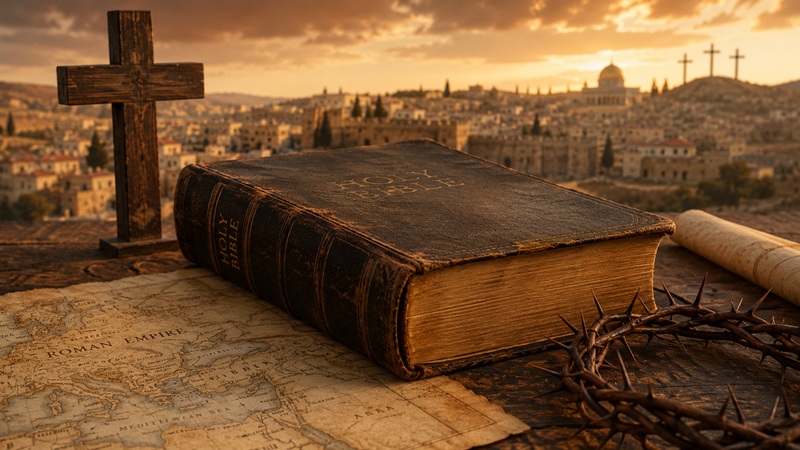
The Bible is Christianity’s sacred Scripture. It consists of the Old Testament, which Christianity shares in large part with the Hebrew Scriptures, and the New Testament, which records the life and teachings of Jesus and the development of the early Christian church.
At the heart of Christianity is the belief that humanity is separated from God by sin and that reconciliation with God is made possible through Jesus Christ.
Christians believe Jesus was crucified, died, was buried, and rose from the dead. His resurrection is central to Christian belief and is celebrated each year at Easter.
Although Christians across the world worship in many different ways and belong to different churches and denominations, their faith centers on Jesus Christ.
When Did Christianity Start?
Christianity began in the first century AD, during the time of the Roman Empire.
There isn’t one universally agreed calendar date that can be called Christianity’s birthday. Christianity grew out of the life and ministry of Jesus and the movement created by his earliest followers.
Jesus was born into a Jewish family and lived in the region controlled by Rome that included Judea and Galilee. His public ministry took place during the early first century.
Jesus gathered disciples around him and taught about God, repentance, forgiveness, love, faith, and the Kingdom of God.
His growing following also brought conflict with religious and political authorities.
Jesus was eventually arrested and crucified under the Roman governor Pontius Pilate, generally dated to around AD 30–33.
Christians believe that Jesus rose from the dead three days after his crucifixion. His followers began publicly proclaiming his resurrection and teaching that he was the promised Messiah.
The events surrounding Pentecost, described in the Book of Acts, are often considered the beginning of the Christian church as an organized community of believers.
Where Did Christianity Originate?
Christianity originated in the eastern Mediterranean, particularly Judea and Galilee, in an area that was under Roman rule.
Jerusalem became especially important to the earliest Christian community.
This is where Jesus was crucified and where his followers gathered after his death. According to the New Testament, it was also where the events of Pentecost took place.
Christianity therefore began within a Jewish religious and cultural setting.
Jesus was Jewish. His earliest disciples were Jewish. The earliest Christians used the Jewish Scriptures, worshiped the God of Israel, and initially understood their movement within that Jewish context.
That began changing as the message about Jesus spread beyond Jewish communities.
How Did Christianity Spread?
Christianity’s expansion from a small group of followers in Judea into a worldwide religion is one of the most important developments in religious history.
The earliest followers of Jesus carried his teachings beyond Jerusalem.
One of the most influential figures was the Apostle Paul.
Paul traveled throughout parts of the Roman Empire, establishing and communicating with Christian communities. Several of his letters became books of the New Testament.
Christianity also benefited from the infrastructure of the Roman world. Roads, cities, trade routes, and widely spoken languages made it possible for ideas and people to travel across great distances.
By the end of the first century, Christian communities existed in numerous parts of the Roman Empire.
Christianity and the Roman Empire
The relationship between Christianity and Rome wasn’t always peaceful.
Early Christians periodically faced persecution because their beliefs could conflict with Roman religious and political expectations. The severity of persecution varied considerably depending on the period and location.
Yet Christianity continued to grow.
A major turning point came during the reign of Emperor Constantine.
In AD 313, Constantine and Licinius agreed on a policy commonly known as the Edict of Milan, granting religious toleration to Christians and others throughout the Roman Empire.
Constantine also became closely involved with Christianity.
In AD 325, he called the Council of Nicaea, an important gathering of Christian bishops that addressed disagreements within the church, particularly questions concerning the nature of Christ.
By the end of the fourth century, Christianity had moved from a periodically persecuted religion to a dominant religious force within the Roman Empire.
A Short History of Christianity
Trying to fit 2,000 years of Christian history into one article means leaving out a lot. Still, several major periods help explain how Christianity became what it is today.
The Early Church
The first few centuries saw Christian communities spreading throughout the Roman world and beyond it.
During this period, Christians debated theology, developed church structures, defended their beliefs, and determined which writings would eventually form the New Testament canon.
Christianity also developed traditions of worship and leadership that would influence the church for centuries.
Christianity After Rome
The Western Roman Empire collapsed in the fifth century, but Christianity survived.
The church became an important institution throughout medieval Europe. Monasteries preserved religious writings and other texts, missionaries carried Christianity into new regions, and churches became central parts of communities.
Meanwhile, Christianity continued developing in the eastern part of the former Roman world centered on Constantinople.
The Great Schism
Differences between Christianity in the eastern and western parts of the Christian world grew over centuries.
These disagreements involved theology, church authority, language, culture, and politics.
In 1054, the division traditionally known as the Great Schism formally separated what became the Roman Catholic Church in the West and the Eastern Orthodox Church in the East.
The actual historical separation was more gradual than a single event in 1054, but that year remains the traditional dividing point.
The Protestant Reformation
Another major division occurred in the sixteenth century.
In 1517, German monk and theologian Martin Luther published his famous Ninety-five Theses criticizing practices within the Catholic Church, particularly issues surrounding indulgences.
Luther’s actions became part of a much larger movement now known as the Protestant Reformation.
Other reformers, including John Calvin and Huldrych Zwingli, contributed to new Christian movements.
The Reformation eventually resulted in numerous Protestant churches and traditions and permanently changed Christianity in Europe and eventually around the world.
Christianity Becomes a Global Religion
European exploration, migration, colonization, and missionary activity carried Christianity into the Americas, Africa, Asia, and other parts of the world.
The history of this expansion is complicated.
Christian missionaries established churches, schools, hospitals, and charitable institutions in many places. At the same time, Christianity’s expansion sometimes became intertwined with European colonialism and political power.
Over the centuries, however, Christian communities increasingly developed their own local traditions and leadership.
Christianity today is truly global and can no longer accurately be thought of as primarily a European religion.
What Do Christians Believe?
Christian traditions differ on many theological questions, but most historic forms of Christianity share several central beliefs.
Christians generally believe:
- There is one God.
- God created the world and humanity.
- Jesus Christ is the Son of God and the Messiah.
- Jesus was crucified and died.
- Jesus rose from the dead.
- Humanity is affected by sin and needs reconciliation with God.
- Salvation is made possible through Jesus Christ.
- The Bible is sacred Scripture.
- Jesus will return.
- There is life after death.
Most Christian traditions also believe in the Trinity: one God understood as Father, Son, and Holy Spirit.
How Christians understand salvation, baptism, Communion, church authority, Scripture, tradition, and many other subjects can differ considerably.
Those differences have contributed to the different branches of Christianity that exist today.
What Are the Main Types of Christianity?
Christianity contains thousands of denominations and independent churches, but most can be connected historically to three broad traditions.
Roman Catholic Christianity
The Roman Catholic Church is the largest individual Christian tradition.
Catholics recognize the Pope, the bishop of Rome, as the church’s highest earthly authority and place importance on both Scripture and church tradition.
Catholic worship centers heavily around the sacraments, particularly the Eucharist, also called Holy Communion.
Eastern Orthodox Christianity
Eastern Orthodox Christianity developed primarily in Eastern Europe, the Balkans, Russia, Greece, and parts of the Middle East.
Orthodox Christianity shares many ancient beliefs and traditions with Roman Catholicism but does not recognize the Pope as having universal authority over the church.
Instead, Eastern Orthodoxy consists of several self-governing churches that share a common theological and liturgical tradition.
Protestant Christianity
Protestant Christianity developed from the Reformation of the sixteenth century.
Protestants generally emphasize the authority of Scripture and salvation through faith in Christ, although beliefs and worship styles vary enormously.
Protestant Christianity eventually produced many denominations and traditions, including:
- Lutheran
- Reformed
- Presbyterian
- Anglican
- Baptist
- Methodist
- Pentecostal
There are also many evangelical, charismatic, nondenominational, and independent Christian churches.
These differences can sometimes make Christianity look fragmented from the outside. But the major Christian traditions all trace their faith back to Jesus Christ and the early Christian church.
Christianity Today
Christianity has changed dramatically in where its followers live.
The latest comprehensive global estimates from Pew Research Center put the Christian population at approximately 2.3 billion people in 2020, or 28.8% of the world’s population. Christianity remained the world’s largest religious group.
But there is an interesting story behind those numbers.
From 2010 to 2020, the number of Christians increased by about 122 million, while Christianity’s share of the world’s population declined. The Christian population grew by roughly 6%, while the world’s non-Christian population grew faster.
Where Christians live is changing too.
Sub-Saharan Africa has now surpassed Europe as the region with the largest number of Christians. Christianity declined substantially as a percentage of the population in North America and Europe between 2010 and 2020, while the Christian population grew strongly in sub-Saharan Africa.
Christianity is also unusually widespread geographically. Pew reported that Christians were a majority in about 60% of the countries and territories included in its 2020 analysis, despite accounting for about 29% of the world’s total population.
So Christianity today is both very old and continually changing.
The faith that began among a small group of people in the eastern Roman Empire is now practiced in virtually every part of the world and expressed through an enormous variety of cultures, languages, churches, and traditions.
Christianity Is More Than Its History
Understanding the history of Christianity helps explain how a small movement that began nearly 2,000 years ago became the world’s largest religion.
But history alone doesn’t explain Christianity.
For Christians, Christianity isn’t simply a historical movement, an institution, or a collection of beliefs. It is ultimately about a relationship with God through Jesus Christ.
This is where I’d hand the article back to you.
I’d add 2–4 paragraphs in your own words here. This is the perfect place to explain what Christianity means to you, rather than having me manufacture that part.
You could then finish with a natural internal link:
My own relationship with Christianity hasn’t followed a straight line. I was raised Christian and grew up going to church, moved away from my faith for a number of years, and eventually came to a deeper faith later in life. I share more about that journey in [My Story].
That ending turns what could otherwise be an encyclopedia article into something that belongs on A Faithful Life.
One other recommendation: I would link to this article prominently from the Faith landing page once it’s published. This is exactly the kind of foundational article that should remain easy to find even after you have dozens of Faith posts.
Eddie van Aken

I am Eddie van Aken. I’m still learning about faith, health, family, purpose, and life itself.
A Faithful Life is where I share some of those lessons, experiences, and questions as I continue my journey.
Pingback: The Devil’s Favorite Tool: Division